
Written by: Oliver Heffron
It’s not easy to separate yourself as a songwriter, especially in the alt-pop space, but Whitney Whitney’s distinct perspective is evident before you even press play—it’s right there in the titles: “Does the Narcissist Need a Kiss?” and “A Man Written By a Woman.” The payoff comes when you actually listen—especially on the hilarious, sharply observed “Isabelle,” a track about the frustration of watching a good guy friend stay loyal to a girlfriend who doesn’t deserve him.
On her new EP, 1.2, out today, the rising LA-based songwriter sharpens that voice across four inventive, emotionally direct tracks, including the breakout “Isabelle” and the slow-building “Dream Girl.” Catching up with Nuance, Whitney Whitney reflects on her musical journey, the new project, and what it means to find herself on the Lollapalooza lineup.
1.2, the second of four EPs leading up to her debut album, One, proceeded by 1.1, demonstrates Whitney Whitney’s unique perspective, and musical range. “I feel like 1.2 is the most different, genre-wise, than anything else that’s coming out on the album,” she says. “It’s dreamy, cinematic, very unexpected. It has a lot of sonic shifts in it.”
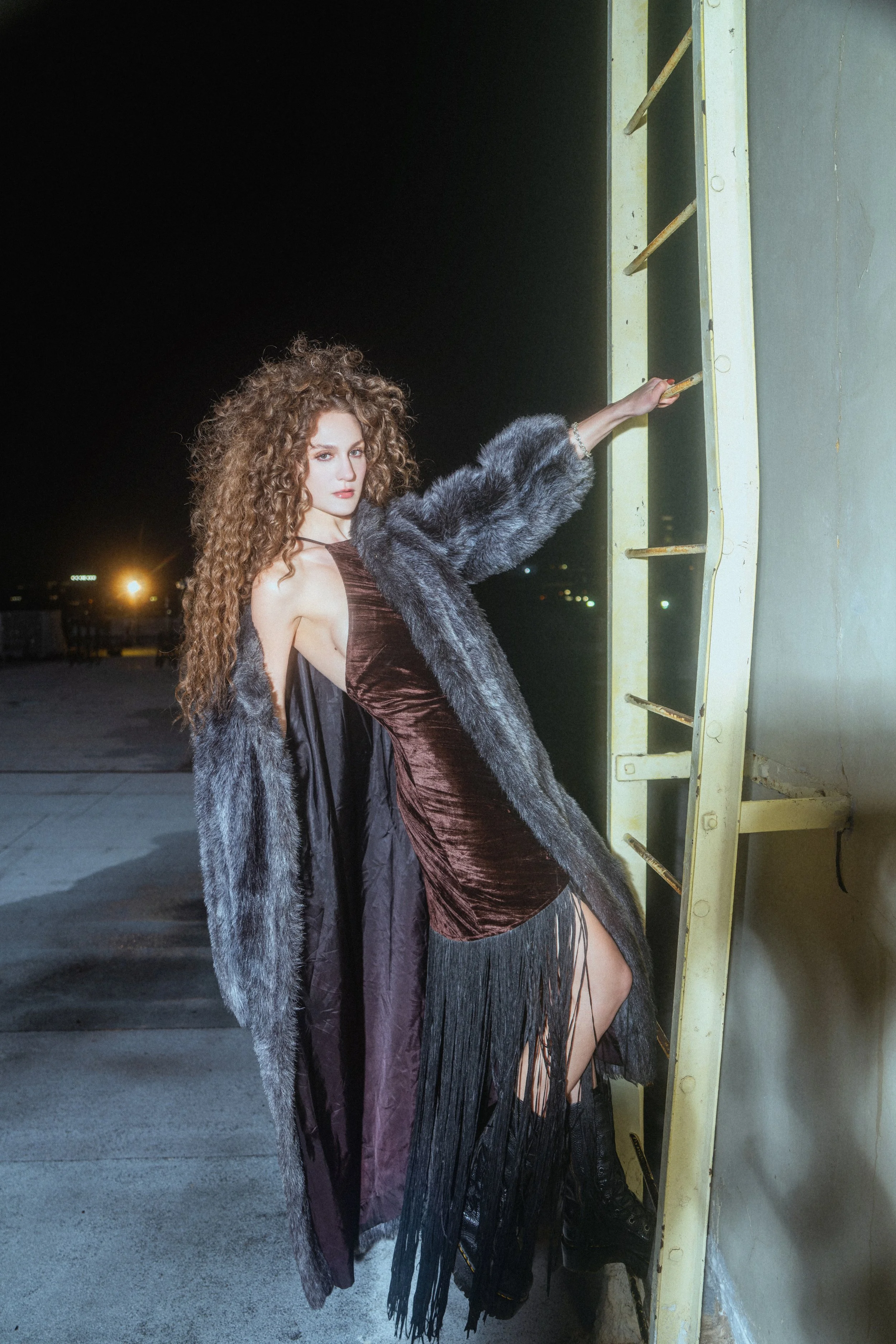
Photo Credit: PAIGE STRABALA
Growing up between Connecticut and Manhattan, Whitney first fell in love with music through musical theater. “I actually started doing musical theater when I was like seven,” she says. “I fell in love with that aspect of music first, and then I wrote my first song at 13.” Inspired early on by Twenty One Pilots, she gravitated toward pop artists with a distinct point of view—Chappell Roan, Billie Eilish, Elton John—artists who bend the form without abandoning it.
Having started so young, the path to making music on her own terms wasn’t straightforward, but it’s something she now sees as essential. “I’m kind of glad I didn’t have any success at a young age,” she says. “I’ve seen so many people go down such bad rabbit holes when that happens.”
A few years ago, she made the decision to start over completely—new name, new approach, and a commitment to making only the kind of music she actually wanted to hear. “Once I decided to follow what I’ve always wanted to do, I finally feel like myself in music,” she says. “I think things are finally starting to come together.”
That sense of creative control defines her sound. “I’ve always kind of wanted it to be a little left of pop,” she says. “I kind of want to throw you off when you’re listening, whether it’s a lyric that’s kind of super weird or a massive shift in sonic land—key changes, tempo changes—I just want to go crazy.” Even in the studio, that instinct leads the process. “I have no knowledge of music theory, so my producers are like, ‘We can’t do that,’ and I’m like, ‘Yes, we can.’ I just love trying this stuff that might not work.”
Working closely with a tight-knit group of collaborators—including producer RISC and producer Noah Conrad, alongside songwriter Cleo Tighe—Whitney sees the studio as a collective space. “The production team I have around me… is just as much the music as I am,” she says. “I have a very close circle of producers and writers—RISC being the main one. He’s done, I think, 11 out of the 16 songs on the album, and I’m just so thankful for him.”
On the euphoric, slow-building “Dream Girl,” that collaborative energy translated into an intense, one-day session. “We wrote ‘Dream Girl’ from 1 p.m. to 2 a.m., and that is what you’re hearing when it comes out,” she says. “It was just a 13-hour sort of whirlwind.” The EP closes with “Tightrope Walker,” its most unpredictable moment. “It is definitely the most wild track on there… I wrote that at a time where I had really nothing going for me musically, and it’s kind of just an ode to myself to always keep going.”
While quick to clarify that she’s not a “man hater,” Whitney leans into both humor and frustration on “A Man Written by a Woman,” a pointed take on modern dating. “I feel like we got texting back—we’re doing the bare minimum, honestly, in this dating realm in 2026—so, texting back. Respect. You can throw in some door holding… No fights, no gaslighting, no lying, no cheating. I would consider that the bare minimum.”
To accompany her recent releases, Whitney has developed a signature visual style built around one-take visualizers, translating each track’s mood into continuous, choreographed sequences. “The funny answer to this is that budget-wise, I couldn’t shoot more, but it was like the best blessing in disguise,” she says. “I found this sort of theme… I think it takes it away from being a visualizer and actually makes it kind of an interesting music video.”
Looking ahead, Whitney is already thinking about how the full One project will come together. Two more EPs—1.3 and 1.4—are still to come, each pushing her sound in new directions. “The next EP, 3, is my piano-driven one—it’s more Elton John,” she says. “It still has the same Whitney Whitney sound to it, but it’s a little bit more organic. Then, EP 4 takes quite a big turn actually. It’s definitely my most pop EP.”
Recently announced as the last artist on the Lollapalooza lineup, Whitney finds herself in a moment that feels both forward-looking and reflective. “I’ve been to Lollapalooza one time when I was like, 15, and I have been doing music since I was 15, so it’s like kind of a full circle moment for me,” she says.
With a songwriting voice defined by unpredictability, emotional precision, and a willingness to follow instinct wherever it leads, Whitney Whitney is carving out a space in alt-pop that feels entirely her own.